
Grad School Admission Statistics: What Actually Predicts an Admit
We went through 138,929 self-reported grad admissions decisions to see what actually separates admits from rejects — and it's not what most applicants spend their energy on.
Every application season the same questions come up: is a 3.4 GPA good enough, is it worth retaking the GRE, does research experience actually matter. We pulled a public dataset of self-reported admissions results and filtered it down to 138,929 decisions with a clear accept or reject outcome, then split the numbers by degree type since Masters and PhD admissions run on very different logic.
GPA matters less than the panic suggests
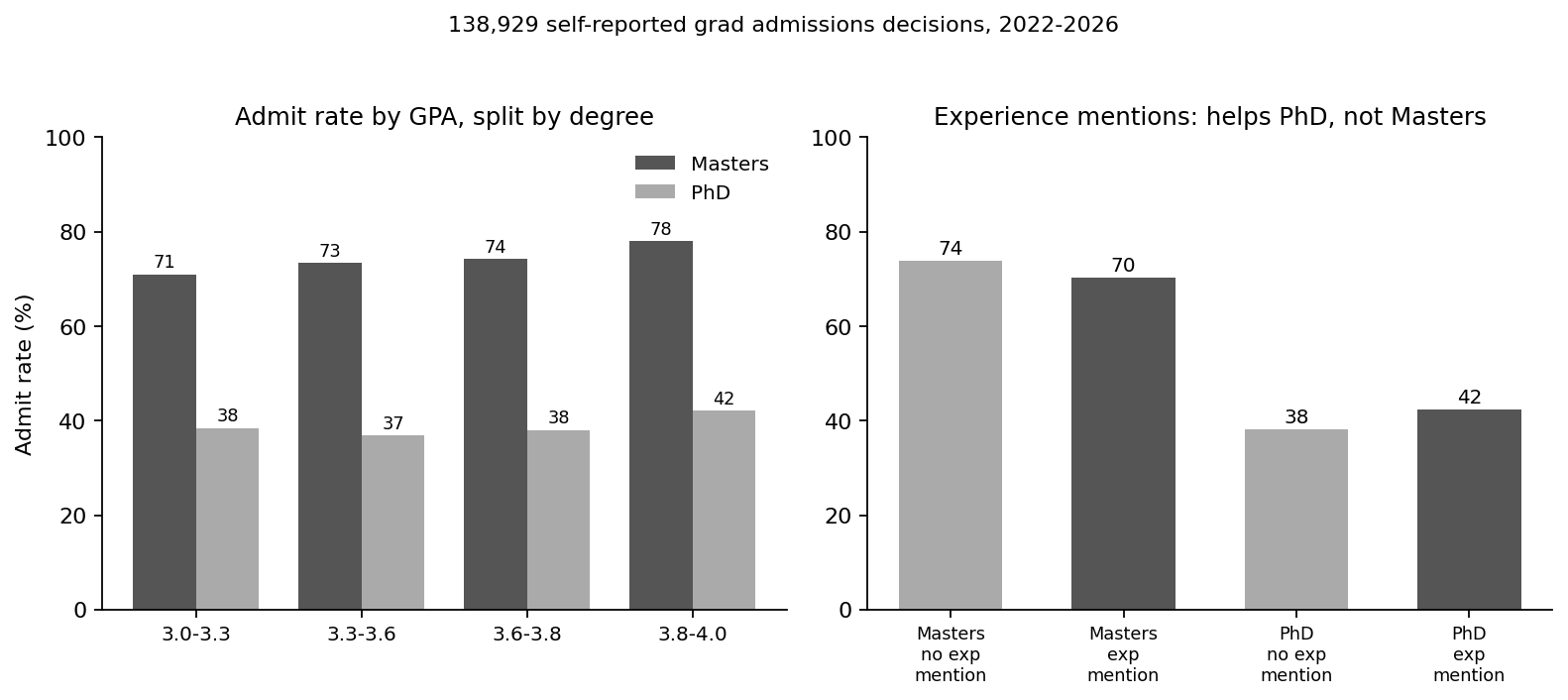
Split by degree, GPA showed a mild slope rather than a hard cutoff. Masters admit rates ran from 71% at a 3.0–3.3 GPA up to 78% at 3.8–4.0 — a real difference, but nowhere near the gap applicants imagine. Even the 2.5–3.0 band came in at 72%. PhD admit rates moved similarly, 38% to 42% across the same range. The takeaway isn't that GPA is irrelevant. It's that a below-average GPA paired with a realistic school list performs far better than most applicants assume.
GRE score moved the needle even less
Among reported GRE scores, 310–320 scorers were admitted at close to the same rate as 330–340 scorers. Twenty points of retake effort bought roughly two percentage points of admit rate. For Masters applicants specifically, reporting a GRE score at all wasn't associated with a higher admit rate than not reporting one — a reminder that in a growing number of test-optional programs, an average score isn't the safety net it's often treated as.
Experience mattered — but only for PhD applicants
This was the most interesting split. When we flagged applications that mentioned research experience, work experience, internships, or publications, the effect was real for PhD applicants: 42.4% admitted with an experience mention versus 38.1% without, and PhD applicants under a 3.5 GPA who mentioned research experience were admitted at nearly the same rate as 3.8–4.0 applicants who didn't. For Masters applicants, the same flag showed no meaningful effect. That tracks with how the two admissions processes actually work — PhD committees are evaluating whether you can do research, Masters admissions lean more heavily on academic record.
What this data can't tell you
This is self-reported data, so it skews toward applicants who chose to log a result and likely overweights admits. The experience flag is a keyword match and misses anyone who didn't describe their background in those terms. None of this splits by field yet — a CS applicant pool and a mechanical engineering applicant pool behave differently, and that's a planned follow-up. It also can't capture what only a program knows: cohort capacity, how many people applied that cycle, entry term, or whether a program is newly launched and still filling seats. Aggregate statistics like these describe the overall shape of outcomes, not any single program's decision.
Want a read on your own SOP before you submit it? Our free SOP Scorer checks whether it actually shows the evidence committees are looking for — no signup required.
Try the free SOP Scorer →Frequently asked questions
Is a 3.3 GPA good enough for grad school?
In this dataset, Masters admit rates from a 3.3 GPA upward stayed in a narrow 71–78% band, and even the 2.5–3.0 range averaged 72%. A 3.3 GPA paired with a school list matched to your actual profile performed close to applicants with higher GPAs.
Does retaking the GRE actually help admissions chances?
Based on this data, the difference between a 310–320 GRE score and a 330–340 score was around two percentage points in admit rate. For most applicants already in a competitive range, the return on a retake is small compared to strengthening other parts of the application.
Does research experience help grad school admissions?
It depends heavily on degree type. In this data, research and work experience mentions were associated with meaningfully higher PhD admit rates, enough to offset a lower GPA. For Masters applicants, the same experience flag showed little to no effect.
What is the admit rate difference between Masters and PhD programs?
Across this dataset, Masters programs admitted 73.5% of applicants and PhD programs admitted 38.4%. The two processes evaluate applicants very differently, so admit rates and advice from one don't transfer to the other.
Is there an admissions gap between international and domestic applicants?
For Masters programs in this dataset, international applicants were admitted at 69% versus 77% for domestic applicants, an 8-point gap most likely tied to funding and cohort capacity rather than applicant quality.
Data source: a public grad admissions results forum, self-reported outcomes 2022–2026, 138,929 decisions after filtering to clear accept/reject outcomes.
